Physical Address
304 North Cardinal St.
Dorchester Center, MA 02124
Physical Address
304 North Cardinal St.
Dorchester Center, MA 02124

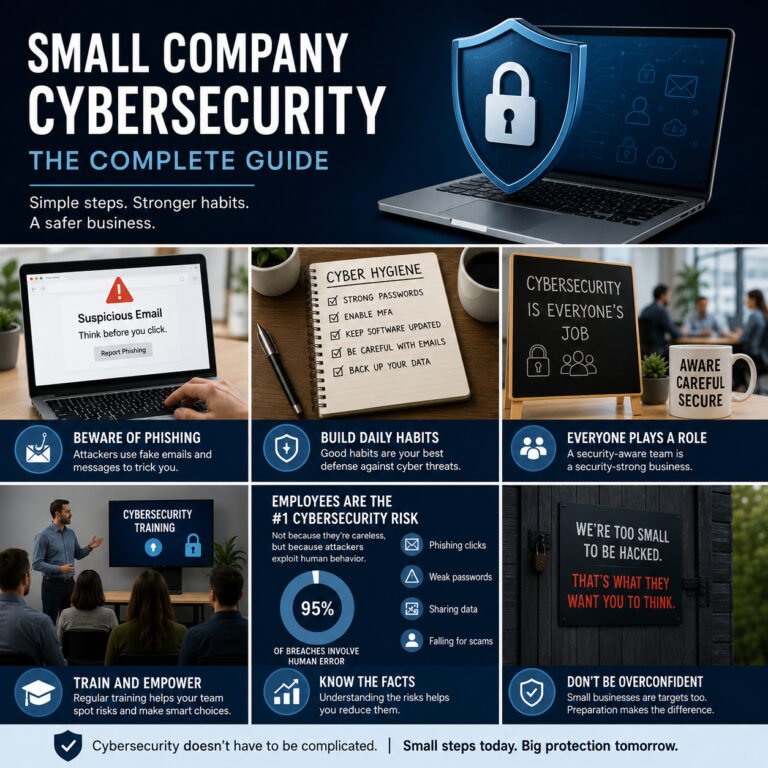
Cyber hygiene for small business is often overlooked because it feels simple and routine, even though it plays a major role in broader small business cybersecurity. Many companies focus on tools and systems, but ignore the daily habits that actually create or reduce risk because they still believe they are too small to become real targets.
In reality, most small business cyber risks start with behavior. Employees reuse passwords, click links without thinking, and trust familiar communication. These actions seem harmless in the moment. However, over time, they create real exposure.
Because of this, many incidents are not caused by technical failures. Instead, they grow out of small, repeated habits that nobody questions until something goes wrong.
Cyber hygiene is not about advanced security knowledge. Instead, it reflects how people interact with technology every day.
It includes:
In short, cyber hygiene for small business is about consistency in everyday actions.
If those actions are careless, risk increases. If they are controlled, risk decreases significantly.
Most cyber attacks and malware infections do not require advanced techniques. Instead, attackers rely on predictable human behavior and weak internal access control.
Attackers expect that:
Because of this, even basic habits can disrupt attacks.
For example:
These actions take seconds, but they break many common malware and phishing attack processes.
Passwords remain one of the weakest points in many companies.
Common mistakes include:
These habits allow attackers to move easily between systems once they gain access.
Better practices include:
Improving password discipline is one of the fastest ways to strengthen cyber hygiene for small business environments.
Multi-factor authentication (MFA) adds a second layer of protection. Even if a password is exposed, attackers still need another step to gain access.
Because of this, multi-factor authentication blocks many common attack paths that rely on stolen passwords.
It should be enabled for:
Employees should also avoid handling sensitive business activity through unsecured public WiFi networks whenever possible.
Without MFA, access becomes much easier to exploit.
Email is still the most common entry point for attacks.
Most incidents start with:
Improving email habits reduces risk significantly:
If something feels slightly off, it usually is.
Many businesses rely on trust in daily communication. While trust is important, it creates risk when not supported by verification.
Attackers exploit this gap.
Instead of assuming messages are safe, employees should:
Cyber hygiene for small business improves when verification becomes standard behavior.
Outdated systems and poorly separated smart devices create easy entry points for attackers.
Many attacks exploit known vulnerabilities that already have fixes available. Because of this, updates should not be delayed.
Basic practices include:
Ignoring updates means leaving known weaknesses open.
Many companies try to improve security by adding tools. However, tools do not fix behavior.
Consistency matters more than complexity.
Repeating simple habits daily creates stronger protection than occasional advanced actions. Cyber hygiene for small business only works when it becomes routine.
Improving cyber hygiene does not require major investment. Instead, it requires structure.
Effective steps include:
Over time, these actions help employees build better habits without resistance.
If employees:
then most attacks fail at an early stage.
Small business cyber risks decrease significantly when daily behavior improves.
Cyber hygiene is not a one-time improvement. It is a long-term advantage.
Companies with strong habits:
Over time, this creates a more resilient business environment.
Cybersecurity does not start with tools.
It starts with habits.