Physical Address
304 North Cardinal St.
Dorchester Center, MA 02124
Physical Address
304 North Cardinal St.
Dorchester Center, MA 02124

Cybersecurity training for small business is often seen as unnecessary, even though it plays a critical role in broader small business cybersecurity. Many companies believe they are too small to be targeted or assume that employees already know what to do.
However, real incidents show a different pattern.
Most attacks succeed not because systems fail, but because employees make quick decisions under pressure. Without training, people rely on intuition, emotional reactions, and automatic trust — exactly what attackers exploit.
Because of this, ignoring training creates a hidden risk that grows over time.
Many businesses focus on the cost of training. However, they rarely consider the cost of doing nothing.
A single human mistake can lead to:
In many cases, the financial impact of one incident is higher than the cost of training for several years.
This is why cybersecurity training for small business should be seen as risk reduction, not expense.
Training does not need to be complex or time-consuming.
Even one hour can:
Employees do not need deep technical knowledge. They need awareness.
That awareness changes how they react in critical moments.
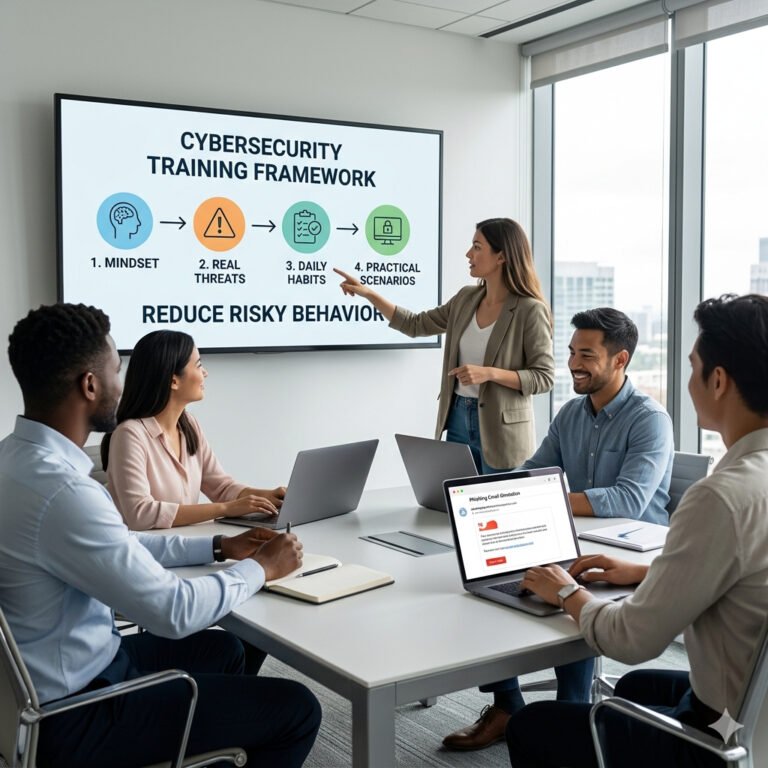
A simple training session can focus on practical cybersecurity awareness scenarios instead of theory.
For example:
When employees see real examples, they remember them.
Because of this, training becomes relevant instead of abstract.
People do not change behavior because of rules. They change behavior because they understand risk.
Without training:
With training:
Cybersecurity training for small business creates this shift from reaction to awareness.
Training alone is not enough. However, it creates the foundation for better habits.
After training, employees are more likely to follow better daily cyber hygiene habits and:
These small improvements significantly reduce risk.
Large companies already have processes, controls, and monitoring.
Small businesses often do not.
Because of this, training has a bigger impact:
Cybersecurity training for small business delivers visible results quickly.
Without training, the same risks remain:
Over time, the probability of an incident increases.
The problem is not if something happens — it is when.
You do not need a complex program to start.
A simple approach:
This creates awareness without overwhelming employees.
Cybersecurity is often treated as a technical issue. However, most incidents start with people.
Because of this, training should not be limited to IT teams.
Everyone who uses email, systems, or shared files plays a role.
Cybersecurity training for small business is a company-wide responsibility.
If employees:
then many attacks fail before they start.
Training does not eliminate risk, but it reduces it significantly.