Physical Address
304 North Cardinal St.
Dorchester Center, MA 02124
Physical Address
304 North Cardinal St.
Dorchester Center, MA 02124

Phishing remains one of the most widespread cyber threats, and it continues to succeed because it targets human behaviour rather than technology. Although security tools have improved over the years, phishing still works because attackers exploit emotions like urgency, fear, curiosity and trust. Many of these attacks rely on the same psychological manipulation techniques commonly used in modern social engineering campaigns. In this guide, you’ll learn what phishing really is, why it stays so effective and how you can protect yourself in a digital environment full of distractions. This article also serves as the introduction to our broader phishing series, where each attack type is analysed in detail.
Phishing is a social engineering attack that attempts to trick people into taking harmful actions — such as entering passwords, downloading malicious files or revealing personal data. Instead of breaking systems, attackers manipulate individuals. Because this approach bypasses even strong technical controls, phishing remains one of the top causes of security incidents globally.
Moreover, phishing has evolved significantly. Attackers now use realistic branding, personalised messages, cloned websites, SMS campaigns, voice calls and manipulated QR codes. As a result, phishing is no longer just a poorly written email. It is a flexible attack technique that adapts to how we live and communicate online.
Additionally, attackers benefit from the fact that people receive overwhelming amounts of digital communication every day. When you are tired, distracted or multitasking, even a seemingly obvious phishing attempt can slip through unnoticed. Attackers also benefit from oversharing habits and publicly available information across social media platforms, which often make targeted attacks significantly easier. This blend of social pressure, digital overload and sophisticated deception explains why phishing is still so dangerous.
Phishing exploits predictable human reactions. Understanding these triggers helps people recognise attacks more quickly.
Attackers often create artificial deadlines to push people into reacting without thinking. Examples include:
Messages pretending to come from banks, HR, IT support or management usually bypass suspicion. When people believe a message originates from a trusted authority, they often comply immediately. This becomes especially dangerous in corporate environments where employees are expected to respond quickly to internal communication, payment requests or executive instructions.
Subject lines like “You have a new message,” “Delivery issue,” or “Important document attached” push users to click impulsively. Such messages seem harmless at first glance, which is why people open them automatically.
Targeted phishing attacks often rely on publicly available information to appear legitimate. Attackers may reference names, job roles, colleagues, internal projects or recent events to increase credibility and reduce suspicion. Much of this information is gathered through social media profiles, public company pages, leaked databases and various OSINT techniques.
Phishing is no longer limited to fake emails filled with spelling mistakes and suspicious attachments. Modern phishing campaigns are highly adaptive and often designed to match the habits, devices, and emotions of specific targets. Some attacks focus on urgency and fear, while others exploit trust, curiosity, convenience, or routine online behavior. In many cases, attackers also abuse deceptive user experiences, manipulative interfaces, and fake urgency to increase click rates.
Today, phishing exists across email, mobile devices, social media platforms, business communication systems, QR codes, and even cloud authentication environments. Many attacks also combine multiple techniques at the same time, making them far more convincing than traditional scams from the past.
Below are the most common phishing methods used by cybercriminals today and why each one creates different types of risks.
Email phishing remains the most common form of phishing worldwide. Attackers impersonate trusted companies, banks, coworkers, delivery services, or online platforms in order to trick people into clicking malicious links, downloading infected attachments, or entering passwords into fake login pages.
Modern phishing emails are often professionally written and visually convincing, especially when criminals clone legitimate branding or exploit current events. Some campaigns now imitate Microsoft 365, Google, Dropbox, or internal company portals so realistically that even experienced users may hesitate before spotting the fraud. Even trained users sometimes fail to notice small signs of manipulation until it is too late.
Unlike mass phishing campaigns, spear phishing targets specific individuals using personal information gathered from social media, company websites, leaked databases, or other OSINT sources. These attacks are carefully customized to appear legitimate and trustworthy. Attackers frequently study LinkedIn profiles, company structures, employee activity, and publicly visible business relationships before launching the attack.
Whaling is a specialized form of spear phishing that focuses on executives, managers, or other high-level employees with access to sensitive systems, financial approvals, or internal business data. Because these attacks are highly personalized, they are often much harder to detect.
Business Email Compromise attacks focus on manipulating trust inside organizations. Criminals may impersonate executives, suppliers, finance departments, or trusted business partners in order to redirect payments, steal invoices, request sensitive documents, or manipulate internal processes.
BEC attacks are responsible for some of the largest financial losses linked to phishing because they rely more on social engineering and psychological pressure than on malware or technical exploits.
Smishing and vishing attacks move phishing beyond email into mobile devices and phone communication. Smishing uses fraudulent SMS messages, while vishing relies on voice calls that impersonate banks, delivery companies, technical support, or government institutions.
These attacks often create urgency by claiming that an account is blocked, a package cannot be delivered, or suspicious activity has been detected. Older adults are particularly targeted by impersonation scams involving fake family emergencies, banking fraud, and technical support calls. Because smartphones have become deeply integrated into daily life, many people react emotionally before verifying the legitimacy of the message.
Social media phishing exploits trust built through online interaction and digital identity. Attackers use fake support accounts, impersonation profiles, hacked pages, marketplace scams, copyright violation warnings, and fake verification messages to manipulate users across platforms like Facebook, Instagram, LinkedIn, TikTok, and X.
In many cases, cybercriminals first collect information about a target’s interests, workplace, relationships, or habits before launching a more convincing phishing attempt. This is why reducing your public digital footprint can significantly lower exposure to targeted phishing attacks.
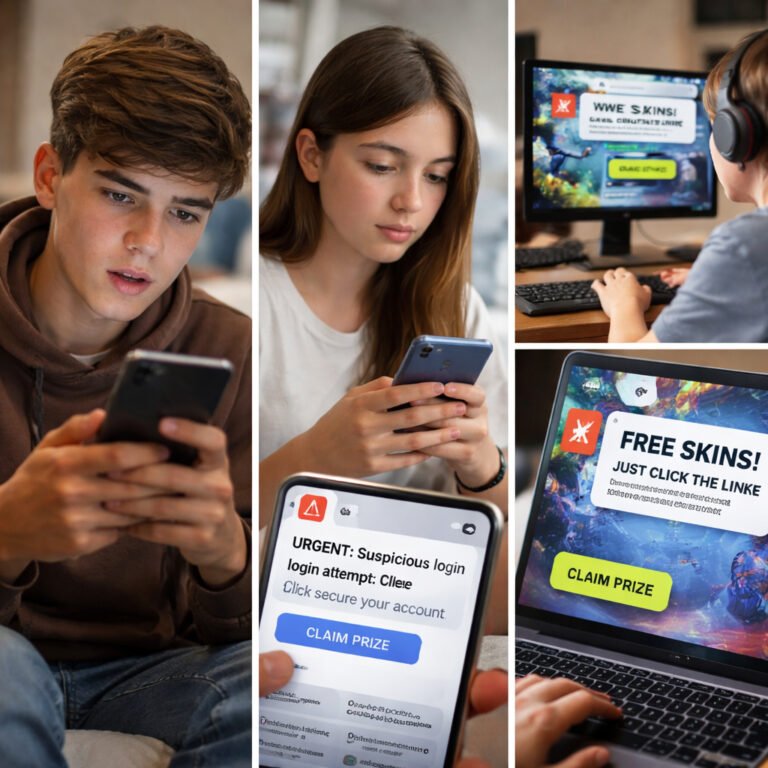
QR code phishing, often called “quishing” abuses the growing habit of scanning QR codes without verification. Attackers place malicious codes on posters, parking meters, restaurant tables, public charging stations, fake payment terminals, or phishing emails. Similar trust-based attacks are increasingly appearing in fake giveaway campaigns, gaming promotions, and influencer scams targeting younger audiences.
Because QR codes hide the destination URL until after scanning, users often trust them automatically. This creates an effective way to redirect victims toward fake login pages, malware downloads, or fraudulent payment systems.
Modern phishing increasingly targets cloud services such as Microsoft 365, Google Workspace, and other identity-based platforms. Instead of simply stealing passwords, attackers now attempt to hijack authenticated sessions, abuse MFA fatigue prompts, or trick users into approving fraudulent login requests.
These attacks are especially dangerous because they often bypass traditional security assumptions. A stolen cloud session may provide direct access to email accounts, company documents, internal communication systems, and sensitive business data without triggering obvious warning signs. This is one of the reasons why modern cybersecurity increasingly follows a “never trust, always verify” approach instead of assuming authenticated users are automatically safe.
Although phishing techniques differ, most successful attacks follow a familiar pattern:
Because each step is simple and fast, victims often don’t realise what happened until the damage is already done.
Phishing is evolving quickly. Several trends make attacks significantly harder to detect.
Attackers now use AI to create grammatically perfect phishing messages, removing traditional warning signs.
Fake login pages copy logos, language, layouts and animations, making them almost indistinguishable from real services.
Small screens hide sender details and URLs, increasing the chance of mistakes.
One attack may start with a text, continue with an email and end with a phone call, reinforcing credibility.
Attackers can capture session tokens and bypass MFA entirely, even if the user recognises the phishing attempt too late.
Phishing is not disappearing. It is becoming smarter, more automated and more personalised. Because phishing targets human behaviour, no single tool will ever eliminate the risk. However, understanding how phishing works, recognising its patterns and applying practical habits can significantly reduce exposure. Long-term protection depends not only on technology, but also on awareness, skepticism, digital hygiene, and understanding how online manipulation works.
This introductory article forms the foundation of our phishing series. Each linked guide explores a specific attack type in depth, creating a clear and structured learning path for understanding and defending against modern phishing threats.