Physical Address
304 North Cardinal St.
Dorchester Center, MA 02124
Physical Address
304 North Cardinal St.
Dorchester Center, MA 02124

Locking your front door keeps intruders out. Checking your bank statement ensures no one tampered with your balance. Opening your laptop and accessing your work files allows your business to function. If you want to understand how these actions connect to digital security, you first need to answer a fundamental question: what is CIA triad and why does it matter?
Known collectively as the CIA triad, these three principles form the bedrock of modern digital defense. For small businesses, freelancers, and everyday users, understanding this model is not about learning complex computer science. It is about knowing what you are actually trying to protect—and how hackers try to exploit your weak points.
The CIA triad is a conceptual model used to guide information security policies within any modern network. It does not refer to the government intelligence agency. Instead, it stands for Confidentiality, Integrity, and Availability.
Think of the triad as a three-legged stool. If one leg snaps, the entire structure collapses, exposing your personal credentials or business operations to immediate risk.
Organizations use this framework to identify vulnerabilities and assess operational risk. When a massive data breach occurs, it is almost always because one or more of these pillars failed.
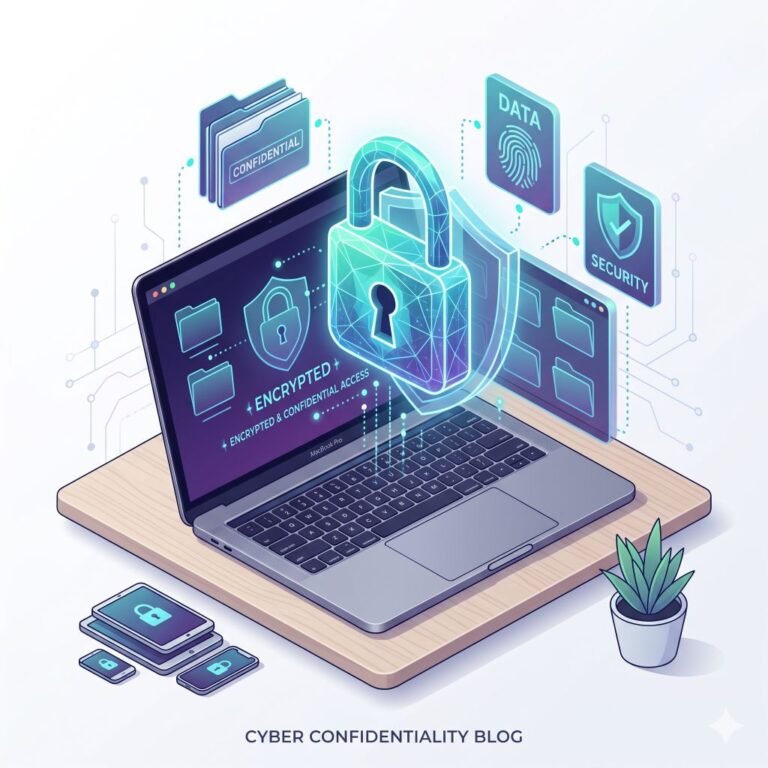
Confidentiality focuses on access control. It ensures that sensitive information remains hidden from unauthorized eyes while remaining fully accessible to those who legitimately need it to perform their work.
Privacy and confidentiality overlap, but they are not identical. Privacy is about rights; confidentiality is about duty. In business, you have a professional duty to protect customer profiles, financial statements, and proprietary software code.
To maintain confidentiality, systems must establish strict boundaries. This requires a robust approach to Identity and Access Management (IAM). Security tools must verify two things:
Without both layers, data exposure is inevitable. Encryption acts as the ultimate safety net here. By scrambling data at rest (on hard drives) and data in transit (moving across the internet), encryption ensures that even if an outsider manages to intercept your files, they only see meaningless, chaotic characters.
Attackers rarely try to crack 256-bit encryption because it takes too much computing power. Instead, breaches often happen due to simple human oversight or misconfigured settings.
Example: Public File Sharing Mistake – A sales manager creates a public shareable link to a Google Sheet containing customer phone numbers and home addresses to send to an external contractor. However, they forget to restrict access, leaving the document open to anyone on the web, and the private link accidentally gets indexed by public search engines.
Instantly, confidentiality is shattered. The data was not stolen by a complex malware strain; it was simply left unprotected. Human error and misconfiguration remain common causes of data exposure. With unsecured permissions, sensitive business details can slip into the public domain in seconds.
Integrity addresses the trustworthiness and purity of your information. Security is not just about keeping secrets. It is about making sure your data is accurate, complete, and completely uncorrupted.
Imagine a medical database tracking patient blood types. If a hacker steals the list, it is a massive breach of confidentiality. But if a hacker subtly changes a patient’s blood type from type O to type AB within the system, it becomes an immediate, life-threatening crisis.
Integrity ensures that data does not change during storage or transmission unless an authorized user intentionally modifies it. This requires modern systems to track data lineage—knowing exactly who created a file, who edited it, and when the change occurred.
The most dangerous integrity attacks are the quiet ones. Hackers do not always delete files or crash networks; sometimes, they just change a few digits on an e-commerce platform or inventory database.
Example: Price Manipulation in an Online Store – An attacker exploits a weak input form on a small online boutique’s checkout page. Instead of stealing credit card numbers, they inject a malicious script that subtly changes the price of a $500 designer jacket to $5 in the database right before completing the purchase.
The checkout system processes the payment smoothly, the order goes through, and the fraud is only discovered days later when shipping staff notice the financial mismatch. The data looked technically valid to the server, but its integrity was completely gone. Leading cyber crime investigations show that silent data modification costs online businesses thousands of dollars in hidden losses before the manipulation is even detected.
Availability ensures that your business can actually operate. Security protocols that lock down data so tightly that employees cannot access it are counterproductive. Systems, networks, and applications must be reliable, fast, and usable on demand.
For a small e-commerce business or a digital service provider, availability translates directly to survival. If your website drops offline for three hours during a peak sales period, you lose money, visibility, and long-term customer trust.
Availability relies on engineering resilience into your infrastructure by eliminating single points of failure. If your business runs entirely on a single local server and your office loses power, your data becomes completely unavailable. Moving operations to redundant cloud environments ensures that if one server fails, another instantly takes its place with minimal disruption.
Attackers know that downtime causes immediate panic, and they exploit this operational vulnerability for financial gain:
Perfect security is a myth because the three pillars of the CIA triad often work against one another. Designing a security strategy requires constant compromise based on your specific business risks.
Consider these trade-offs:
Security professionals must assess which pillar takes priority for different types of data. Public marketing materials require 100% availability, but zero confidentiality. Internal payroll records require absolute confidentiality and integrity, even if accessing them requires extra verification steps that slow down availability.
The original CIA triad was designed decades ago when data stayed within local networks and physical office servers. In the modern cloud ecosystem, these physical boundaries have completely dissolved. Remote work, mobile devices, and third-party software vendors have forced the triad to adapt.
Because of this shifting perimeter, modern security professionals often add three supplementary principles to the core triad:
Don’t let corporate acronyms or legal terms scare you. Even if you run a team of two, international compliance frameworks use the CIA triad as a helpful blueprint to keep your operations safe. When your small business grows and needs to prove its security posture to larger clients, you will encounter these standards:
Translating the CIA triad into action does not require a massive IT budget. Small businesses can strengthen all three pillars by focusing on fundamental digital habits.
Stop giving every employee administrator access to every system. Implement the Principle of Least Privilege (PoLP). A marketing assistant does not need access to financial accounting software, and a sales representative does not need access to the website’s source code. Limit access to the bare minimum required for each role.
Use cloud storage solutions that include automatic version control. If a file is accidentally altered or hit by malware, versioning allows you to roll back the clock to a verified, uncorrupted state. Turn on audit logs in your workspace (like Google Workspace or Microsoft 365) so you can track exactly who modifies files.
Do not trust a single backup solution. Follow the industry-standard 3-2-1 rule to survive ransomware and hardware failures:
The CIA triad simplifies the overwhelming world of cybersecurity into three manageable goals. Your objective is not to build an impenetrable system, but to understand where your data is vulnerable. By identifying whether a threat targets your privacy, your accuracy, or your uptime, you can deploy the right tools to keep your digital operations stable and secure.