Physical Address
304 North Cardinal St.
Dorchester Center, MA 02124
Physical Address
304 North Cardinal St.
Dorchester Center, MA 02124

Employee cybersecurity training framework is often missing in small businesses, even when companies understand the importance of training. Without a clear structure, training becomes inconsistent, difficult to remember, and disconnected from real work situations.
As a result, training becomes:
Employees listen, but they do not apply what they hear.
However, effective training does not require complexity. It requires clarity. When training is structured around real behavior and real situations, it becomes useful instead of theoretical.
A simple framework can make the difference between employees forgetting everything — and actually changing their behavior.
This is exactly where an employee cybersecurity training framework becomes essential.
Before building any training session, it is important to define the goal.
The goal is not to teach employees everything about cybersecurity. Most of that information is not needed in daily work.
Instead, the goal is to:
Employees do not need to become experts. They need to recognize situations and react correctly.
Because of this, training should focus on behavior, not theory.
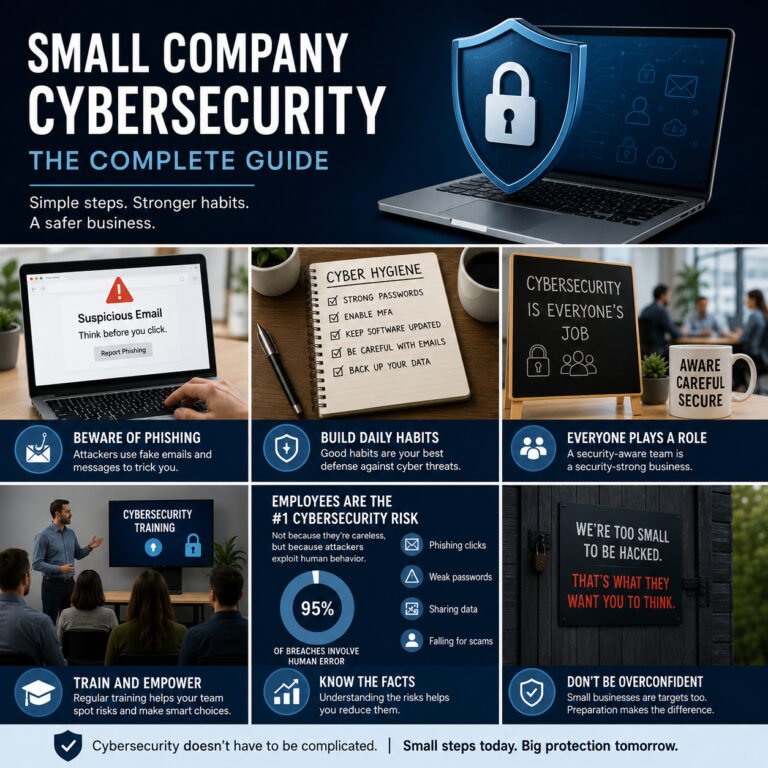
A practical training session can be built around four core elements:
This structure keeps training focused and easy to follow. It also ensures that employees move from understanding to action.
Each part builds on the previous one, creating a logical flow that improves retention.
Training should start with mindset. Without it, everything else feels optional.
Employees need to understand:
Many employees believe cyber attacks only target large organizations, even though modern small business cybersecurity risks affect companies of every size.
Once employees realize that:
their attention changes.
Mindset creates awareness. Without it, habits do not stick.
After mindset, training should focus on real threats.
Avoid abstract explanations. Instead, show how attacks actually happen.
Focus on:
For each threat, explain:
Cybersecurity training becomes effective when employees recognize patterns, not definitions.
This is the most practical part of training.
Employees need clear, simple cybersecurity habits they can follow every day.
Key habits include:
The key here is simplicity.
If habits are too complex, employees will not follow them. If they are clear and repeatable, they become automatic over time.
Scenarios are what make training stick.
Without scenarios, training remains theoretical. With scenarios, employees learn how to think in real situations.
Use examples like:
These situations force employees to pause and think.
Because of this, scenarios should not be optional — they should be a core part of the employee cybersecurity training framework.
Many companies repeat the same mistakes:
As a result, employees disengage quickly.
To avoid this:
Training should feel relevant, not overwhelming.
Long training sessions do not improve results. In many cases, they reduce attention.
A more effective approach:
Short cybersecurity awareness sessions are easier to absorb, easier to repeat, and often more effective for small businesses.
Training should not end after one session.
To make it effective:
Behavior changes through repetition, not information.
A well-structured employee cybersecurity training framework supports this repetition over time.
If employees:
then most attacks fail early.
This does not require advanced tools. It requires awareness and consistency.
Good training does not overload people.
It prepares them for the moment that matters.