Physical Address
304 North Cardinal St.
Dorchester Center, MA 02124
Physical Address
304 North Cardinal St.
Dorchester Center, MA 02124

Small business cybersecurity is no longer optional for modern companies. Small business owners often imagine cyberattacks as something reserved for giant corporations, banks, or government agencies. It feels distant. Expensive. Technical. Like a problem for somebody else.
That belief is exactly why so many small businesses become easy targets.
Cybercriminals rarely care whether a company has 5 employees or 5,000. What matters is whether the target is vulnerable, unprepared, distracted, or easy to manipulate. Small businesses often check all four boxes.
Today, many attacks are no longer carried out manually by elite hackers sitting in dark rooms. Instead, modern cybercrime is heavily automated. Bots constantly scan the internet looking for weak passwords, outdated systems, exposed services, poorly configured websites, or employees willing to click the wrong email.
For attackers, small businesses are often easier to compromise than large enterprises because they usually have:
And yet, small businesses still store valuable information.
For example, small businesses often store customer data, invoices, email accounts, payment information, contracts, internal documents, and access to suppliers or partners.
In some cases, criminals do not even care about the data itself. Instead, they simply want access to a business email account they can abuse for scams, fraud, impersonation, or malware distribution.
The good news is that most attacks against small businesses are not highly sophisticated. Many are preventable with simple habits, basic awareness, and a more realistic understanding of modern cyber risks.
One of the biggest misconceptions in cybersecurity is the idea that attackers only go after large companies.
In reality, attackers often prefer easier targets.
A small business may not have millions in the bank, but it often has something much more attractive: weak defenses.
Automated attacks do not care about company size. Cybercriminals use scanning tools that search the internet for vulnerable systems 24 hours a day. If a business uses weak passwords, outdated software, insecure remote access, or poor employee security habits, it can become a target simply because it appeared on a scan.
As described in The Art of War, successful attackers often focus on weakness rather than direct confrontation. Modern cybercriminals follow the same logic by targeting the easiest victims first.
Many small business owners still believe:
Unfortunately, this creates a dangerous false sense of safety.
The reality is closer to what is described in the article about why small businesses are often targeted despite their size. Small organizations are frequently attacked precisely because they are less prepared.
A criminal does not need to steal millions from one company if they can compromise hundreds of small businesses with minimal effort.
Not every cyberattack is about dramatic ransomware headlines or massive data breaches.
In many cases, attackers simply want access to email accounts, saved passwords, payment details, employee login credentials, customer information, remote access to devices, or the ability to impersonate a company.
At the same time, many businesses underestimate how valuable even basic information can become.
An attacker who gains access to a single employee mailbox may:
As a result, this type of fraud has become extremely common through attacks known as Business Email Compromise (BEC).
Unlike movie-style hacking, BEC attacks often rely more on manipulation than technical sophistication. Criminals study communication patterns, imitate trusted contacts, and pressure employees into making mistakes.
The psychology behind these attacks is deeply connected to how cybercriminals exploit human trust, fear, urgency, and emotional reactions.
For example, attackers often rely on fear, urgency, authority, curiosity, and trust to manipulate people into making rushed decisions.
Attackers understand that humans are often easier to manipulate than computers.
One of the hardest truths for businesses to accept is that employees do not need to be careless or unintelligent to create security risks.
Even smart, experienced, responsible people make mistakes when distracted, rushed, tired, stressed, or overloaded.
Modern phishing emails are no longer filled with obvious spelling mistakes and cartoon-like scams. Some are highly convincing and designed specifically for busy employees.
A single click on:
…can be enough to compromise an account.
Because of this, human error remains one of the largest cybersecurity problems worldwide.
The problem is not stupidity. Instead, humans are emotional, distracted, rushed, and imperfect by nature.
Moreover, this becomes even more dangerous inside small businesses where employees often wear multiple hats and move quickly between tasks.
Even healthy companies remain vulnerable when employees are distracted, overloaded, or manipulated. Attackers do not need everybody to fail — they only need one person.
Many small businesses still see cybersecurity training as a boring corporate exercise. In many cases, it is treated as something done once a year, a simple checkbox, or merely a compliance requirement.
That mindset misses the real purpose of training.
Good cybersecurity awareness training changes behavior.
It teaches employees how modern attacks actually work. It helps them recognize manipulation. It normalizes caution. It reduces panic-based decision making.
Most importantly, it creates a culture where employees stop assuming that “IT will handle everything.”
Ultimately, no firewall can fully protect a company if employees willingly hand access to attackers.
For that reason, even simple awareness sessions can dramatically reduce risk.
Even short cybersecurity awareness sessions can significantly reduce business risk because training does not need to be complicated to change employee behavior.
In many small businesses, even one hour of practical awareness training is already far better than nothing.
One reason many organizations avoid cybersecurity training is because they imagine complex technical presentations filled with jargon.
Effective awareness training is usually much simpler.
Employees do not need to become cybersecurity experts.
They need practical survival skills.
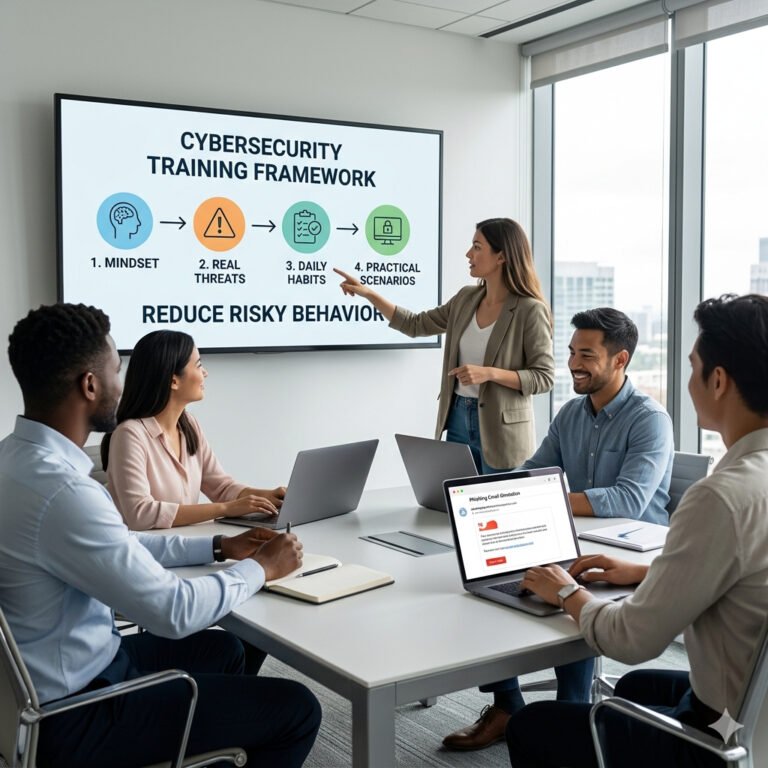
A useful training framework should cover:
Employees should understand how phishing emails work, why urgency is dangerous, how fake login pages steal passwords, how scammers imitate trusted brands, and why unexpected attachments are risky.
Practical examples matter more than theory.
Additionally, employees should learn why password reuse is dangerous, how password managers help, why strong passwords matter, and how breached credentials are abused.
Unfortunately, many attacks succeed because employees reuse the same password across multiple services.
At the same time, businesses should encourage MFA wherever possible.
Multi-factor authentication is now one of the most important basic security protections because it blocks many real-world attacks even when passwords are stolen.
Employees should also understand risks involving public Wi‑Fi, unknown USB devices, personal device usage, outdated software, and insecure remote access.
Even simple awareness about unsafe public networks can prevent credential theft or session hijacking.
One of the most overlooked areas of cybersecurity training is encouraging employees to report suspicious behavior early.
Many people stay silent because they fear embarrassment. Unfortunately, that delay can give attackers valuable time to expand access or steal additional information.
Healthy security culture matters.
Instead, employees should feel comfortable saying:
Fast reporting often prevents small mistakes from becoming major incidents.
Practical employee cybersecurity awareness training should focus on real business situations, repeatable habits, and simple decision-making frameworks employees can apply daily.
Importantly, one of the biggest myths in cybersecurity is that protection always requires expensive enterprise tools.
In reality, many successful attacks exploit extremely basic weaknesses.
In fact, simple cyber hygiene still blocks a huge percentage of real-world threats.
This includes updating software regularly, using MFA, backing up important data, avoiding password reuse, limiting unnecessary access, separating work and personal accounts, and teaching employees how scams work.
None of these actions are glamorous.
But they work.
Simple cybersecurity habits dramatically reduce risk for small businesses because consistency usually matters far more than perfection.
Cybersecurity is rarely about becoming invincible.
It is about becoming a harder target than the next vulnerable business.
However, many people still think malware only affects careless users downloading suspicious files from random websites.
Modern malware spreads in many different ways.
Businesses can become infected through:
For instance, some malware steals passwords, while other variants spy on activity or silently join infected devices into botnets. In more serious cases, ransomware encrypts files and demands payment for recovery.
Malware often spreads through common business and everyday online behavior, which means even ordinary actions can create infection opportunities.
Consequently, this is another reason employee awareness matters so much.
A business does not need an advanced targeted attack to suffer damage.
Sometimes a single fake invoice attachment is enough.
Traditionally, cybersecurity discussions often focus heavily on technical vulnerabilities.
However, many successful attacks rely primarily on manipulating human psychology.
This is called social engineering.
Attackers exploit:
A criminal pretending to be:
…may convince somebody to willingly reveal passwords or transfer money.
This is why cybersecurity is not only a technical issue.
It is also a human behavior issue.
The strongest firewall in the world cannot fully protect a business if employees are manipulated into opening the door themselves.
Additionally, one of the reasons some business owners avoid cybersecurity improvements is because the topic feels overwhelming.
There are endless tools, countless threats, and constant recommendations online. Because of that, many business owners feel overwhelmed before they even begin improving their security.
As a result, that can create paralysis and prevent companies from improving even their most basic protections.
But cybersecurity does not need to start with perfection.
Most small businesses can improve their security dramatically by focusing on basic priorities first:
These fundamentals already reduce risk significantly.
As a result, many attacks succeed because organizations skip the basics entirely.
Importantly, good cybersecurity awareness is not about paranoia.
It is about realism.
Modern businesses operate in an environment where cyber threats are part of everyday life. Ignoring them does not make them disappear.
At the same time, small businesses should not believe they are helpless.
In reality, most criminals are opportunistic.
They usually look for:
That means even moderate improvements can make a meaningful difference.
In reality, cybersecurity is often less about building an impenetrable fortress and more about removing the obvious opportunities attackers rely on.
For many small businesses, the biggest step is simply moving from denial to awareness.
After that mindset shift happens, smarter security habits usually follow naturally.
Small businesses are not invisible online.
They are scanned, tested, targeted, and manipulated every day alongside larger organizations.
The difference is that many small businesses still underestimate how modern cybercrime actually works.
Most attacks are not cinematic. Instead, they are practical, automated, psychological, and opportunistic.
In many cases, a reused password, a fake invoice, a rushed employee, an outdated device, or a missing backup is all attackers need to compromise a business.
That is often enough.
The encouraging part is that most businesses do not need massive budgets to improve their security posture.
Basic awareness, better habits, employee training, and consistent cyber hygiene already prevent many of the attacks criminals rely on most.
Cybersecurity is no longer only an IT problem.
For modern businesses, it is part of basic business survival.